
Most tradespeople reach for a 13mm chuck because they think bigger always means better. But for precision work in cramped engine bays or overhead cabinetry, that extra bulk is your biggest enemy. Understanding specific 10mm chuck drill uses reveals why a compact tool often outperforms larger models on the job site. You shouldn't have to sacrifice power just to fit your tool into a tight corner or to save your shoulders during a long day of overhead installs.
We understand the frustration of tools that feel like dead weight by mid-afternoon. This guide proves that a smaller chuck size doesn't mean a lack of professional capability. You will discover how a 10mm chuck provides superior precision and ergonomics without losing the torque required for tough materials. We will cover bit compatibility, professional trade applications, and why a 150Nm brushless motor makes the 10mm format a top-tier choice for serious work. It's time to stop viewing the smaller chuck as a compromise and start seeing it as a specialized tool for high-performance results.
Key Takeaways
- Learn why 10mm chucks are the professional standard for cabinetry and electrical work where space is limited.
- Discover specific 10mm chuck drill uses that prioritize precision and accessibility over raw tool bulk.
- Compare the weight and ergonomics of 10mm versus 13mm models to reduce fatigue during overhead tasks.
- Understand how a 150Nm brushless motor provides the high-torque performance needed for demanding trade environments.
- Get clarity on bit shank compatibility to ensure your setup is optimized for the most common drill and impact bits.
Understanding the 10mm Drill Chuck: Size vs. Utility
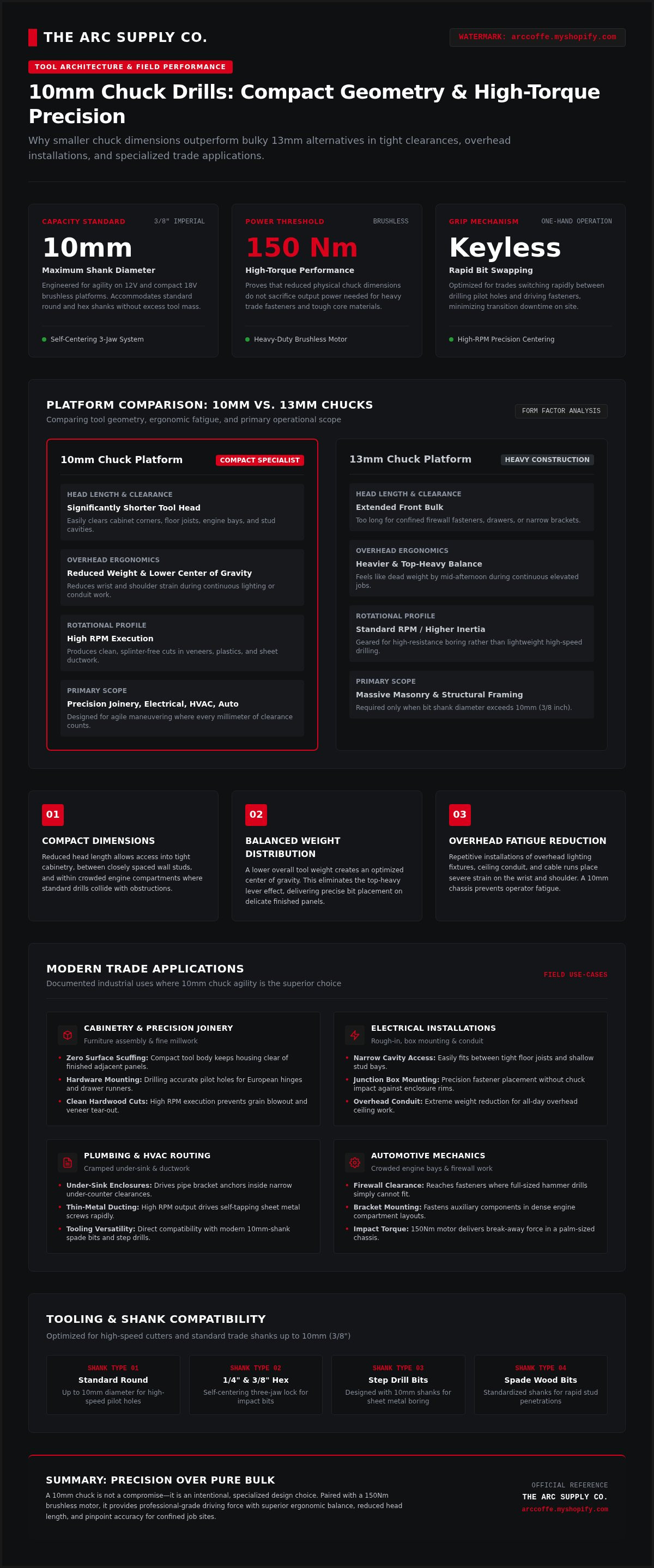
A 10mm chuck refers to the maximum diameter of the bit shank the tool can accept. In the imperial system, this is roughly 3/8 of an inch. While larger 13mm models dominate heavy construction, 10mm chuck drill uses focus on precision and high-speed execution. These tools are the backbone of compact cordless platforms. They prioritize speed and accessibility where a larger drill would be too cumbersome. You'll find these chucks on tools designed for agility; they're built for the professional who needs a reliable driver that won't crowd a tool belt or strain a wrist.
What defines a 10mm chuck capacity?
The core of the tool is the three-jaw drill chuck mechanism. This self-centering design uses three internal jaws that tighten simultaneously to grip the bit. A 10mm capacity means the jaws open wide enough to hold a 10mm round or hex shank. This size is the standard for 12V tools and ultra-compact 18V brushless models. Most modern versions are keyless. They allow for rapid bit changes with a single hand. This efficiency is critical for tradespeople who toggle between drilling pilot holes and driving fasteners. The grip is firm and centered; it's optimized for smaller bits that require high RPMs for clean cuts in metal, wood, or plastics.
The trade-off: Weight, size, and ergonomics
Choosing a 10mm chuck is a strategic decision. You exchange the ability to use massive masonry bits for a significant reduction in tool head length. A shorter head allows you to reach into tight cabinetry, engine bays, or between wall studs. It's about maneuverability. When you're working in a confined space, every millimeter of clearance counts. A compact 10mm drill fits where a standard 13mm driver simply can't reach.
- Compact Dimensions: Reduced head length for tight clearances in joinery and electrical boxes.
- Weight Distribution: Lower overall tool weight reduces the center of gravity for better control.
- Balance: Optimized for vertical or overhead drilling without the top-heavy feel of larger chucks.
User fatigue is a real factor on a long shift. Holding a heavy 13mm drill overhead to install conduit or lighting fixtures leads to strain. A 10mm drill is lighter and more balanced. It's easier on the wrist and shoulder. When you don't need the massive shank capacity of a larger tool, the 10mm format provides a more ergonomic experience. It doesn't sacrifice professional-grade power, especially when paired with a 150Nm brushless motor. It's the smarter choice for repetitive trade tasks where speed and comfort are the priority. Professional 10mm chuck drill uses prove that efficiency often beats raw size.
Essential Uses for a 10mm Chuck Drill in Modern Trades
Professional work often happens in spaces where a full-sized hammer drill won't fit. While some dismiss smaller tools as hobbyist gear, 10mm chuck drill uses in industrial settings tell a different story. These tools are built for precision, speed, and accessibility. They allow tradespeople to operate in confined areas without sacrificing the power needed to drive fasteners or bore through tough materials.
Precision woodworking and cabinetry
Cabinetry and furniture assembly demand high accuracy and zero surface damage. When you're installing European hinges or drilling pilot holes for drawer slides, a bulky drill body can easily scuff adjacent surfaces. A 10mm drill offers a compact footprint that keeps the tool away from finished panels. This Encyclopedia Britannica overview of drill and chuck mechanics highlights how bit geometry and rotational speed affect material removal; 10mm drills typically provide the high RPMs necessary for clean, splinter-free holes in hardwoods and veneers. Matching the torque to these delicate materials prevents over-driving and stripping.
Electrical and plumbing installations
Rough-in work frequently places tools between floor joists or inside narrow wall cavities. Electricians use 10mm drills for mounting junction boxes and drilling through studs for wire runs. Plumbers find them invaluable for securing pipe brackets in cramped under-sink areas. While you're limited to bits with a 10mm shank, many modern spade bits and step drills are designed specifically for this format. The reduced weight is a massive advantage when you're working overhead on lighting fixtures or conduit runs all day.
HVAC technicians and mechanics also benefit from this specialized size. Metal ductwork requires high-speed drilling for self-tapping screws, a task where a light 10mm tool excels. In automotive repair, engine bays are increasingly crowded. A 13mm drill is often too long to reach firewall fasteners or bracket mounts. A high-torque 10mm impact model provides the necessary force in a package that fits in the palm of your hand. For those facing these daily challenges, the Cordless Brushless Impact Drill 150Nm 10mm Chuck offers the perfect balance of size and strength.
10Mm vs. 13mm Chucks: Which Should You Choose?
The assumption that a 13mm chuck is the default professional choice is a common misconception. For many daily tasks, the larger chuck adds unnecessary weight and length. The decision comes down to the shank size of your bits and the environment where you work. While a 13mm chuck accepts larger masonry and timber auger bits, the 10mm format is the sweet spot for the majority of residential trade work. It's about matching the tool to the specific application rather than carrying excess capacity you won't use.
Bit compatibility and shank limitations
Understanding shank geometry is critical for maximizing 10mm chuck drill uses. A 10mm chuck accepts all standard round-shank twist bits up to 10mm and the ubiquitous 1/4-inch hex-shank impact bits. Many tradespeople worry about larger hole requirements, but reduced-shank bits allow you to run larger diameters in a 10mm system for occasional tasks. However, for high-volume work with large-diameter holes, the 13mm remains the heavy-duty standard.
- Twist Bits: Full compatibility for standard metal and wood sets up to 10mm.
- Hex-Shank Bits: Perfect retention for 1/4-inch driver bits and impact-rated spade bits.
- Reduced-Shank Bits: Allows for larger diameter boring in softer materials while maintaining a 10mm grip.
- Masonry Bits: Compatible with most standard residential sets; larger SDS-style bits require a different platform.
Weight and accessibility advantages
The extra 3mm of capacity in a 13mm chuck comes with a physical penalty. The chuck itself is larger, heavier, and requires a longer tool head to house the mechanism. This extra length becomes a hindrance when you're working between floor joists or inside a vanity unit. A 10mm drill is shorter and better balanced. This balance is vital for one-handed operations where you need to hold a workpiece with your free hand. Weight matters when you reach hour eight of a shift. A lighter tool reduces the risk of repetitive strain and keeps your movements precise.
Don't confuse a smaller chuck with a lack of power. Modern engineering has closed the gap. When you pair a 10mm chuck with a 150Nm brushless motor, you have enough torque to drive heavy fasteners that would have previously required a much bulkier tool. We focus on high-performance options like Milwaukee Power Tools because they understand this balance. If your work involves repetitive fastening, precision drilling, and tight spaces, the 10mm platform offers a more efficient workflow without the bulk of a 13mm alternative.
Maximizing Your 10mm Drill Performance
Performance in a compact tool is a result of motor technology and user technique. While we've discussed the portability of these tools, maximizing 10mm chuck drill uses requires an understanding of how to handle high-output torque. A 10mm chuck doesn't mean you're limited to light-duty tasks; it means you need to be more intentional with your setup to ensure the tool's 150Nm rating translates into work rather than wasted energy.
Matching bits to the 10mm capacity
The most common failure point is bit slippage. Since a 10mm chuck has a smaller surface area for its jaws to grip, choosing the right shank is vital. For metal and hard plastics, use bits with flatted shanks whenever possible. These provide a mechanical lock that prevents the bit from spinning under load. Step bits are another essential accessory; they allow you to bore large-diameter holes in sheet metal while keeping the shank size within the 10mm limit.
Regular maintenance keeps the grip strong. Dust and metal shavings accumulate inside the keyless mechanism, preventing the jaws from closing fully. Blow out the chuck with compressed air weekly. A drop of dry PTFE lubricant on the jaw threads ensures smooth operation without attracting more debris. This simple routine ensures your 10mm chuck drill uses remain efficient over the long term.
Managing high torque in small chucks
Handling 150Nm of torque in a lightweight frame requires a firm, two-handed grip for heavy fastening. Brushless motors eliminate friction and voltage drop to provide consistent, electronically controlled torque through the entire drilling cycle. This technology ensures that the power doesn't bog down when the bit encounters a knot or a structural metal plate. It allows a compact tool to punch well above its weight class.
To prevent bit spin-out during high-torque applications, follow these steps:
- Clean the shank: Remove oils or grease from the bit before insertion.
- Ratcheting Lock: Hand-tighten the keyless chuck until you hear the final click of the ratcheting mechanism.
- Impact Rating: Use impact-rated bits designed to handle sudden torque spikes without shearing.
Heat is the enemy of both the motor and the chuck jaws. When drilling through thick metal or masonry, avoid continuous trigger pulls. Use a pulsing technique to allow the flutes to clear debris and let the motor's internal fan cool the coils. This practice extends the life of your tool and maintains the integrity of the chuck's grip. If you're ready for a tool that handles these demands, explore the Cordless Brushless Impact Drill 150Nm 10mm Chuck for your next project.
Why the 150Nm Cordless Impact Drill is the 10mm King
The outdated idea that 10mm drills lack professional power is a myth. Modern brushless technology has changed the landscape. You can now find 150Nm of torque in a package that fits in your palm. This high output ensures you can drive long timber screws or penetrate thick steel without the bulk of a traditional hammer drill. Professional 10mm chuck drill uses aren't limited by power; they're defined by how efficiently that power is delivered in tight spaces. It's about density. You get the same force as a larger tool in a frame that doesn't crowd your tool belt.
Professional-grade specs in a compact frame
The Cordless Brushless Impact Drill 150Nm 10mm Chuck represents the pinnacle of compact utility. Its 150Nm torque rating is more than enough for stubborn fasteners and high-resistance drilling. Brushless motors are the heart of this performance. They eliminate the friction and mechanical wear found in brushed models; this means more power goes directly to the chuck and less energy is wasted as heat. It's a no-nonsense approach to tool design that prioritizes longevity and consistent output.
Ergonomics are just as important as internal specs. This drill is balanced for the job site. The grip is textured for use with gloves, and the weight is centered to prevent the tool from tipping forward during delicate pilot hole work. When you're working 10 hours a day, these small details matter. You need a tool that feels like an extension of your arm, not a weight you're fighting against. This level of durability and precision is why the Milwaukee range continues to set the standard for professional hardware.
Shop high-performance tools at The ARC Supply CO.
We provide direct access to high-performance hardware through a streamlined online experience. There's no need to navigate a physical showroom or deal with equipment rental services. Our Shopify store is built for the professional who knows what they need and wants it delivered fast. We focus on curated equipment like Milwaukee Power Tools because we know they stand up to the rigors of the workshop and the campsite alike.
Buying direct means you get clear specifications and honest utility. We act as a bridge between high-performance industrial gear and the people who use it every day. Whether you're an electrician, a cabinet maker, or a dedicated DIYer, your kit should reflect the quality of your work. Don't let a bulky 13mm drill slow you down when a compact king is available. It's time to work smarter and lighter.
Upgrade your kit with the 150Nm 10mm Impact Drill and experience the difference that professional-grade compact power makes on your next project.
Equip Your Kit for Precision and Power
Selecting a 10mm chuck is a strategic move for professionals who value accessibility and precision. These tools aren't just for light DIY; they're essential for cabinetry, electrical rough-ins, and automotive work where space is at a premium. By prioritizing a compact 10mm chuck design, you reduce user fatigue and gain the ability to operate in confined engine bays or narrow cabinetry without scuffing finished surfaces.
Understanding the full range of 10mm chuck drill uses ensures you don't carry more tool than you actually need. High-performance models now feature brushless motor efficiency that delivers a 150Nm high-torque output. This proves that a smaller frame can handle heavy-duty fastening without compromise. It's about finding the balance between rugged durability and industrial precision. If you're ready to upgrade your loadout with a tool built for the modern job site, it's time to invest in specialized gear.
Shop the 150Nm Cordless Brushless Impact Drill at The ARC Supply CO. and get the power you need in a format that works for you. Keep building and exploring with equipment you can trust.
Frequently Asked Questions
Can I use a 13mm drill bit in a 10mm chuck?
You cannot fit a standard 13mm shank bit into a 10mm chuck. The maximum jaw opening is physically limited to 10mm. To use larger bits, you must purchase reduced-shank bits where the base is machined down to 10mm or less. This allows you to bore larger holes while maintaining a secure grip within the tool's intended capacity. It's a common solution for occasional large-diameter tasks.
What is the difference between a 10mm and 13mm chuck?
The primary difference is the maximum shank diameter the jaws can accept. A 10mm chuck is smaller and lighter, making it ideal for specialized 10mm chuck drill uses in cramped environments. A 13mm chuck is larger and accept heavier bits but adds significant weight and length to the tool. The 10mm format prioritizes ergonomics and accessibility for precision trade work over raw bit capacity.
Is a 10mm chuck drill powerful enough for masonry?
Yes, provided the tool has an impact or hammer function. Modern brushless motors provide the torque necessary for small-diameter masonry tasks like drilling into brick or mortar for wall plugs. While a 10mm drill is compact, it handles standard residential masonry bits with ease. For heavy-duty work in reinforced concrete or large-diameter holes, a dedicated SDS-plus rotary hammer remains the professional standard for the job.
What shank size bits do I need for a 10mm chuck?
You need bits with a shank diameter of 10mm or smaller. This includes all standard 1/4-inch hex-shank bits used for driving and impact drilling. Most twist drill sets up to 10mm will fit without issue. If you need to bore larger holes in wood or metal, look for reduced-shank bits that feature a 10mm base. This ensures compatibility with the three-jaw mechanism while providing a larger cutting head.
Can I replace a 10mm chuck with a 13mm chuck?
Replacing the chuck is generally not recommended. 10mm drills are engineered for specific weight distributions and motor loads. Installing a heavier 13mm chuck can unbalance the tool and put unnecessary strain on the internal gearbox. If your work consistently requires 13mm shanks, it's better to invest in a tool designed for that capacity. Using the tool as intended ensures the best longevity and performance on the job site.
Why do some professional drills still use 10mm chucks?
Professional tools use 10mm chucks to maximize maneuverability and reduce user fatigue. In trades like cabinetry, electrical work, or automotive repair, a 13mm chuck is often too bulky to fit into corners or narrow cavities. The smaller chuck allows for a shorter tool head, providing essential clearance in tight spots. It's a deliberate design choice that prioritizes speed and precision for high-volume, repetitive trade applications.
Is 150Nm of torque too much for a 10mm chuck?
No, a high-quality 10mm chuck can easily handle 150Nm of torque when the bit is seated correctly. This high-torque output allows the tool to drive heavy fasteners that would normally require a much larger drill. The key is using impact-rated bits and ensuring the keyless mechanism is fully ratcheted. This combination provides professional-grade power in a compact frame, making it a highly efficient choice for demanding trade environments.